The Forecast Effect: How weather apps are reshaping visitor behaviour
Whether it’s a family day out, a visit to a heritage site, or a spontaneous trip to a theme park, the British public increasingly turns to weather apps as their decision-making compass. For operators of outdoor attractions, these forecasts have become a critical, and sometimes frustrating, part of the visitor economy. Some attraction owners report that a single rain symbol can cost them up to £122,550 in a day, and our research supports the impact of rain in the forecast, with an increase from 20% to 40% for the chance of rain driving an incremental third of consumers to change their plans.
Based on a nationally representative survey of 1,000 UK adults, our latest research highlights a clear behavioural shift: weather apps are not just influencing decisions, they are actively reshaping them.
Weather checking is universal and acts as a gatekeeper
Checking the weather is now a near-universal habit.
96% of people check the forecast before deciding whether to visit an outdoor attraction.
53% check on the day itself.
Weather information is not a background factor. It plays a direct and immediate role in decision-making, particularly for activities that do not require advance booking.
This reliance is driving last-minute decisions
Visitors are increasingly waiting until the last moment to commit.
61% make their go or no-go decision either the day before or on the day itself.
For attractions, this creates a volatile operating environment. Short-term forecasts combined with last-minute decisions can quickly translate into unpredictable attendance.
The rain symbol is a powerful behavioural trigger
The rain icon on a weather app carries far more weight than a simple graphic. It acts as an emotional signal.
When shown a rain symbol for a planned visit:
42% say they would change their plans
45% say it might influence a change
In total, more than 8 in 10 people become hesitant or negative when rain is forecast. This helps explain the sharp drops in visitor numbers reported by operators when forecasts appear unfavourable.
There is clear evidence here to support the frustrations of attraction owners by compressing the entire days weather into one icon driving an emotional response of ‘don’t go’.
Consumers are looking beyond the headline, but not enough
While the daily symbol is influential, people are increasingly seeking more detail:
59% check hourly forecasts
53% look at the percentage chance of rain
This creates an opportunity. Attractions can encourage visitors to look beyond the headline icon, particularly on days where rain is intermittent or unlikely during peak visiting hours.
There is also a role for weather providers. Greater clarity around when rain is expected, and what probability percentages actually mean, would help consumers make more informed decisions.
Forecast inaccuracy is creating frustration and regret
Weather apps are not perfect, and consumers know it. 60% say they have cancelled plans due to a poor forecast that later turned out to be better than expected. This highlights a disconnect between how forecasts are interpreted and what actually happens, with a rain symbol often taken as a full-day washout even when the reality is far more mixed.
This creates frustration for both consumers and operators, and reinforces cautious behaviour over time.
Small changes in probability drive big changes in behaviour
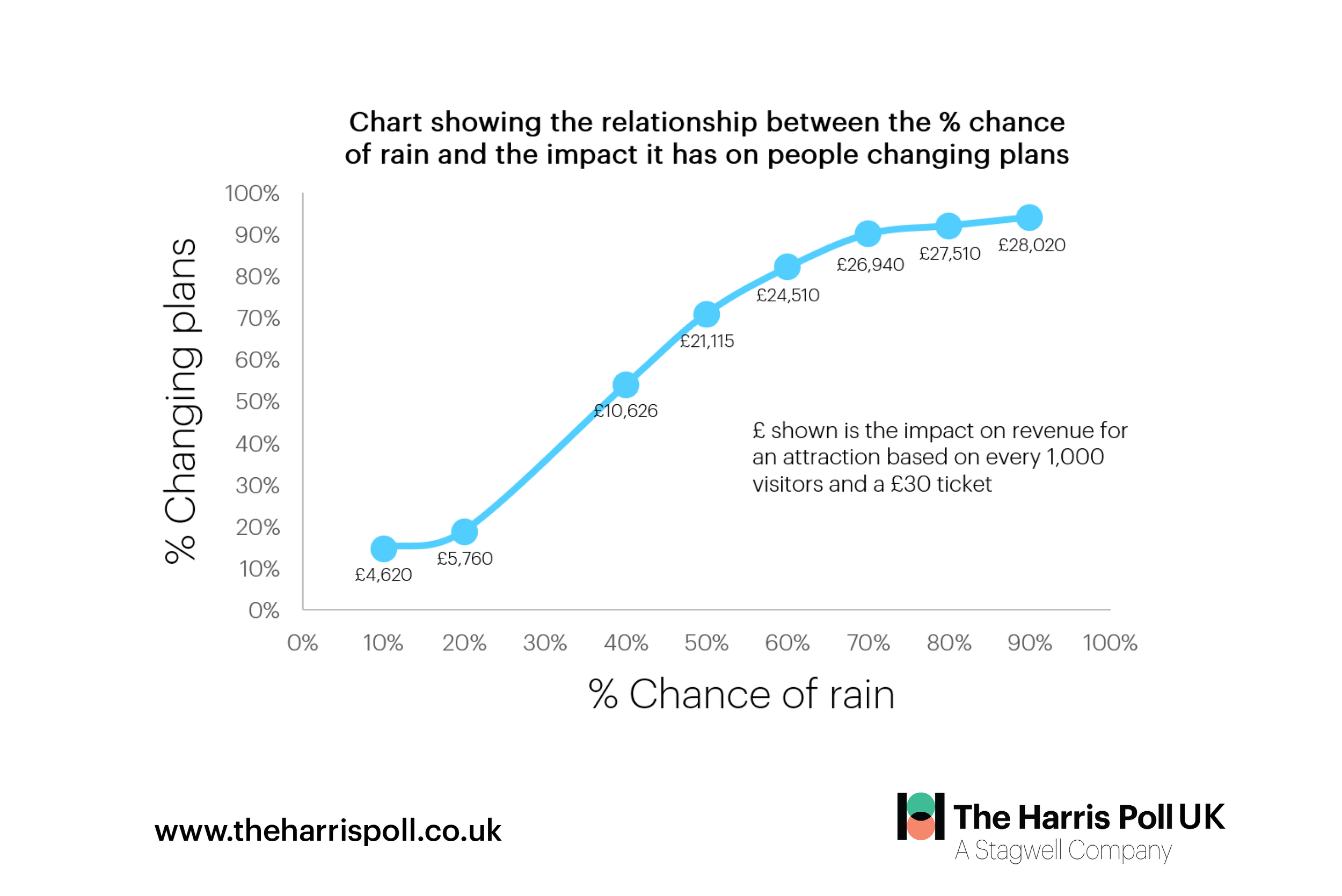
The most compelling insight in our research is the insight that rain probabilities are often interpreted pessimistically triggering a change of plan.
At a 20% chance of rain, 19% of people say they would change plans
At 40%, this rises sharply to 55%
At 50%, around 70% are influenced to change plans
There is a behavioural tipping point between a 20% and 40% rain probability. A 40% chance of rain is rarely interpreted as a 60% chance of dry weather. Instead, it is read as risky. The result is a behaviourally amplified effect with even a low chance of rain becoming a powerful deterrent.
For attractions, this has real financial consequences. Based on an expected 5,000 visitors on a Bank Holiday at £30 per ticket, this shift in behaviour could result in a loss of £122,550 in revenue.
The way weather forecast data is presented can quite literally make or break key trading days.
What this means for brands and operators
1. Reframe how consumers interpret “bad weather”
The real issue is not just the forecast, it’s how people interpret it. There is a clear opportunity to reframe how visitors think about “bad weather days”.
Nearly two thirds (64%) respond positively to flexible ticketing that allows them to postpone their visit. This is less about the mechanic itself, and more about what it signals. It reduces perceived risk and gives consumers the confidence to commit in the first place.
2. Build your commercial model around weather-driven behaviour
Flexible ticketing is becoming essential, but it must sit within a broader commercial strategy.
Encouraging advance booking, using pricing to incentivise earlier commitment, and building in flexibility helps smooth demand, reduce last-minute volatility, and protect revenue from sudden shifts driven by forecast changes.
3. Communicate beyond the weather icon
Reframing only works if it shows up clearly in how you communicate.
Attractions need to go beyond the weather icon by adding context and specificity. That could mean highlighting dry windows, promoting indoor or sheltered elements, or sharing real-time updates on conditions.
4. The outdoor leisure industry to work in tandem with forecasters and weather apps
The insight from our research indicates consumers may be interpreting weather icons and probabilities of rainfall differently to what is intended by the forecaster. Alternative strategies could include
Focussing on daytime hours for the weather symbol, rather than entire 24 hours
Having a summary with the icon e.g. rain early, brighter and drier in the afternoon
Presenting the probability of dry hours rather than rain e.g. 60% chance of staying dry rather than 40% chance of rain.
The brands that succeed will be those that actively interpret the forecast for their audience, rather than leaving consumers to make their own assumptions.
A final thought
Weather apps have become an invisible but powerful force in the UK visitor economy.
A single icon or percentage chance of rain can influence millions of decisions, often in ways that are overly cautious or misinformed. There is a clear opportunity for weather providers to clarify the way they present forecasts and communicate weather data, particularly in how risk is framed.
At the same time, attractions are not powerless. Those that understand this new decision-making landscape and respond to it can turn uncertainty into opportunity, building resilience, improving communication, and ultimately welcoming more confident visitors through their gates.
Getting this right will turn weather driven hesitation into weather resilient demand and open the gates to more visitors, more often.
This is just one example of how small signals can have an outsized impact on behaviour. If you’re interested in how similar dynamics might be shaping your sector and performance, we’d be happy to talk.