
Articles
Our team brings fresh perspectives, proprietary data and consumer insights that help brands thrive.
Insight you can act on: Fresh perspectives powered by trusted research.

Building on TSMs: Understanding the connection between home, belonging and trust
The future of housing cannot be built around averages
A recurring theme from Housing 2026 in Manchester last week was that the future of housing cannot be built around averages. Whether discussing resident engagement, service design, trust or community investment, there was a growing recognition that people experience home in profoundly different ways. Expectations differ according to life stage, lived experiences, family circumstances, capability and local context. The things that create security, belonging and pride for one resident are not necessarily the same as those that matter most to another. Trust can be remarkably fragile when residents' concerns are funnelled through processes built around the needs of an imagined average customer. Without empathy, flexibility and clear ownership, even well-intentioned services can leave people feeling unheard and unsupported.
Resilient for Now: The UK withstands early Middle East shocks, but fragility and risks remain
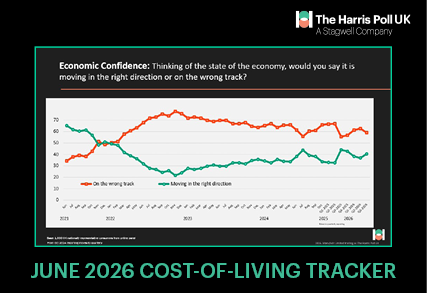
Our latest quarterly update suggests the UK economy has so far absorbed the initial shocks from the Middle East conflict without tipping into outright recession or triggering a fresh, energy-led inflation surge. That resilience is reflected in a small uptick in economic confidence and in consumers’ self-assessed finances in our Q3 Outlook, after three quarters of decline. Yet the improvement is only tentative. As higher fuel and energy prices tied to the conflict feed through the economy during the second half of 2026, we could witness delayed inflationary pressures. Consumer behaviour also shows households are not yet convinced enough to increase spending significantly.

Trust and Financial Guidance: The support gap consumers are trying to close
Managing our money has probably never been more important. Yet for many consumers, particularly younger adults, knowing where to turn for trusted financial guidance remains a challenge. The UK cost of living crisis remains a very real issue; consumers are often having to choose between spending now (at times just to keep their heads above water) vs trying to save for the future.
So, while managing money well is vital, do consumers feel they have the knowledge and support to do it effectively?

The Last 365 Days: A challenging year, or a year of challenge?
One year ago today, we became The Harris Poll UK.
As a team, we've spent more than 25 years helping clients understand people. Last June marked the start of a new chapter. It brought our experience together with the global heritage of The Harris Poll and gave us an even stronger platform to help clients navigate an increasingly demanding world.
To mark the anniversary, we decided to do what we do best and asked UK consumers to reflect on their last 365 days in a single word. The most common answer was, perhaps unsurprisingly, 'Challenging'.

More Than Football: Why we all need a World Cup right now
Every Men’s World Cup arrives with familiar conversations about favourites, form, and whether England's men might finally bring it home. Yet when we asked a nationally representative sample of 1,000 UK adults about the upcoming tournament, the most interesting story wasn't really about football at all.

Beyond the Review: What consumers expect from feedback today
Online reviews remain an important source of information for consumers. Our latest research shows that 95% use reviews when making a purchase or choosing a service, while 84% consider them an important part of the decision-making process. Among under-55s, that rises to 92%.
But while reviews remain influential, consumers are becoming more sceptical about what they read. Increasingly, they are looking beyond ratings alone and paying closer attention to how brands respond to and act on feedback.

Fewer Drinks, Higher Stakes: Unlocking growth for brands in a moderating market
The UK’s relationship with alcohol is changing in ways that are gradual but fundamental. What we are seeing is not a short-term reaction to initiatives like Dry January, but a deeper behavioural shift shaped by cost-of-living pressures, a growing focus on health and wellbeing, and evolving social norms.
Over two in five UK adults (41%) say they are drinking less than they were two to three years ago, compared to 17% who report drinking more, yet this is not a story of disengagement. Nearly half (49%) still drink weekly or more, and 73% have consumed full-strength alcohol in the past six months, pointing to a market that remains active but is being approached with greater intention.

Why the next competitive advantage in financial services may come from emotional intelligence, not just digital efficiency
Financial services is a sector balancing rapid digital change with very human expectations. For years, the industry has focused heavily on digital transformation. Faster journeys, smarter tools, AI-powered support and seamless experiences have become the benchmark for progress. In many ways, consumers have embraced that evolution.
Our latest research at The Harris Poll UK shows digital financial services are now firmly embedded into everyday life. Around 6 in 10 consumers now use mobile wallets regularly, with 30% saying they have become their default payment method. Quick payments, easy day-to-day banking and convenience are now among the strongest-performing aspects of the category, particularly amongst younger consumers who increasingly see digital-first money management as the norm rather than the exception.

The Last Mile Matters: Why delivery experiences are critical to customer retention
We’re buying more online than ever before. Retailers have spent years optimising the online checkout journey, but for many customers the real moment of truth comes after they click “buy”. Customers expect to receive their items quickly and efficiently, but in many cases, this isn’t happening.
Delivery issues are commonplace, with over half (58%) of UK consumers who’ve received a delivery in the last six months experiencing a problem. Clothing and/or footwear (43%) and grocery (30%) were the sectors where consumers were most likely to report delivery problems.
Outsourcing fulfilment to courier companies is now standard practice. Just 9% of deliveries are made by retailers’ own delivery teams, many of these in the grocery sector. However, even where fulfilment is outsourced, poor delivery experiences can still have significant consequences for retailers.
Trusted, But Traded Down: How Own-Label Became Good Enough to Challenge Brands
The relationship between UK shoppers and brands is not breaking down. In many ways, it remains intact. What is changing is the role brands play in everyday decision-making. The shift is not that brands have got weaker. What has changed is how competitive own-label has become. Consumers still value brands but rely on them less.
Our latest research at The Harris Poll UK, based on a nationally representative sample of 1,000 grocery shoppers, shows that brand perception is still positive. 64% of consumers believe branded products are higher quality, 59% see them as more consistent, and 57% say they taste better. These are not weak numbers. But they are no longer decisive.

The Cost of Getting There: How rising fuel prices are reshaping everyday spending
The everyday journey is no longer routine
Have you noticed fewer cars on the roads lately? It’s not your imagination. For many of us, it’s now something we think twice about. Rising fuel costs are reshaping how, when and why people travel.
Our latest research shows that 59% of UK drivers have used their vehicle less in the past three months. This is not just about driving less. Even routine journeys are now being questioned.
From Domestic Pressure to Global Shock: How the cost-of-living crisis is evolving
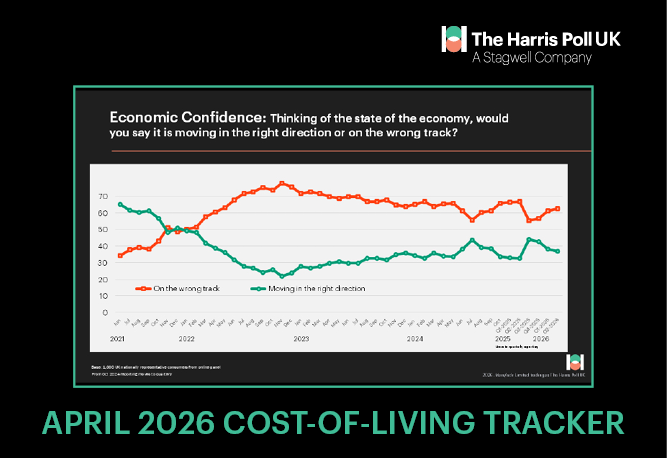
Since 2020, we have tracked UK consumer sentiment and behaviour as the cost-of-living crisis has unfolded through multiple phases.
Our latest Q2 2026 data points to a clear shift: underlying pressures have not disappeared, but the drivers are changing. External factors are reasserting themselves, adding a new layer of volatility just as households were beginning to adjust.

Looking Beyond The Purchase Price: What car buyers want in 2026
In our recent article, Spending with care: the current reality of big-ticket purchases in the UK, we explored how consumers are continuing to engage with major purchases, but with a more considered mindset. Spending has not stopped, but expectations around what feels manageable and worthwhile have shifted.
Automotive brings that mindset into sharper focus. It is a category where the financial commitment is high, the decision is rarely impulsive, and the consequences of getting it wrong feel more significant. As a result, it shows more clearly what consumers need to move from consideration to action.
Our data demonstrates what car finance providers need to be thinking about when shaping their propositions and customer conversations in 2026 and beyond.

The Exit Experience: A new battleground for edge in the subscription economy
Subscriptions are built on the promise of convenience. Increasingly, however, that promise is being tested not at the point of sign-up, but at the point of exit. From streaming and gaming to fitness and food delivery, they have reshaped how people access products and services, offering flexibility and ongoing access that has quickly become part of everyday life. As subscriptions evolve, that promise is increasingly judged by how straightforward it is to leave.

The Authenticity Trade-Off: How AI is reshaping trust in advertising
As the Advertising Standards Authority increases its focus on misleading imagery, and platforms like TikTok continue to favour raw, unfiltered content, brands are facing a different kind of creative pressure. At the same time, categories like food are already under scrutiny through HFSS regulation, with higher expectations around realism and representation. This is the environment AI-generated advertising is entering.
AI offers clear advantages in speed, scale and cost. But our latest research at The Harris Poll UK suggests a more complicated picture. While AI may make it easier to produce advertising, it may also make it harder to earn belief.
Short-term travel plans hold firm, but signs of hesitation emerge among UK consumers
Recent geopolitical tensions and disruption to international aviation routes have created uncertainty around how UK travellers may respond in their holiday planning. In partnership with Travel Weekly, The Harris Poll UK surveyed a nationally representative sample of UK adults in mid-March 2026 to understand initial consumer reaction.
The research explored near-term travel intentions, recent shifts in booking behaviour, destination preferences, and confidence in travelling to or via Gulf destinations. It also examined how willingness to travel abroad varies across different time horizons over the coming year.
The findings offer an early indication of how global instability is shaping travel decision-making. They highlight the extent to which consumers are delaying commitments, reassessing risk and adapting plans rather than stepping away from overseas travel altogether.