
The Last 365 Days: A challenging year, or a year of challenge?
One year ago today, we became The Harris Poll UK.
As a team, we've spent more than 25 years helping clients understand people. Last June marked the start of a new chapter. It brought our experience together with the global heritage of The Harris Poll and gave us an even stronger platform to help clients navigate an increasingly demanding world.
To mark the anniversary, we decided to do what we do best and asked UK consumers to reflect on their last 365 days in a single word. The most common answer was, perhaps unsurprisingly, 'Challenging'.
Rising costs, geopolitical uncertainty, rapid advances in technology and a constant stream of difficult headlines have all shaped daily life across the UK over the past year. The choice of ‘Challenging’ captures something quite important about the moment we find ourselves in. Consumers could just as easily have described the year as difficult, stressful, expensive or exhausting, and many did. But challenging feels different because it acknowledges the reality of the pressures people have faced, while also hinting at something more positive.
Why 'challenging' may be the most revealing word of all
Challenge is an interesting concept because it can be interpreted in two very different ways. On one hand, it describes the obstacles placed in front of us: rising costs, uncertainty, disruption and complexity that make life feel harder than it used to. On the other, it implies a response. It suggests adaptation, problem-solving and finding ways to move forward when circumstances change, in other words, rising to the challenge.
Looking across the research we've conducted over the last year at The Harris Poll UK, we’ve seen that both interpretations are true. Consumers have faced no shortage of challenges. Yet repeatedly we have seen evidence of people adapting to them; they are finding new ways to manage household budgets and rethinking how and where they spend their money. They are learning to navigate new technologies, adjusting their expectations, and prioritising what matters most.
That doesn't mean people are finding things easy, far from it. What it suggests is that the story of the last year is not simply one of struggle. It is a story about how different groups of consumers are responding to that struggle, and how confident they feel about what comes next.
The UK is a country united on the past, but divided on the future
UK consumers broadly agree on the nature of the last year. The language they use may differ slightly, but the overall picture is consistent on the theme of uncertainty and change. Where opinion starts to diverge is when we stop asking about the past and start asking about the future.
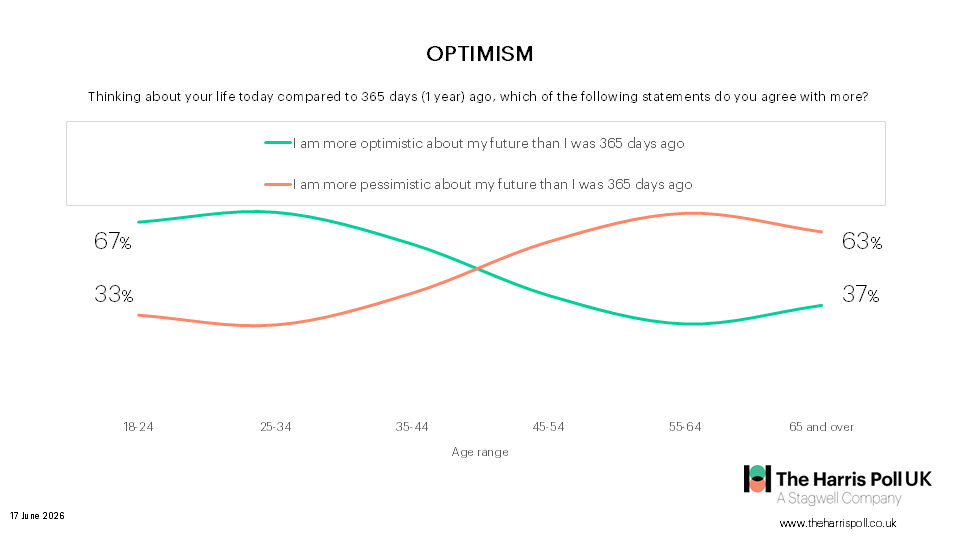
When we asked people whether they felt more optimistic about their future than they did a year ago, a clear divide emerged. Among younger adults, optimism comfortably outweighs pessimism. By middle age, the relationship reverses, and among older generations pessimism becomes the dominant sentiment.
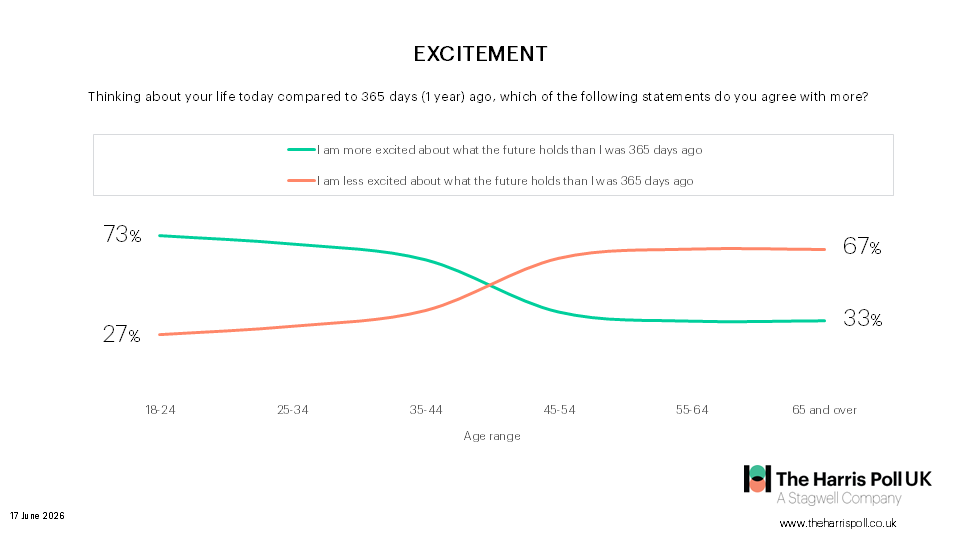
The same pattern appears when we asked whether people are more excited about what the future holds than they were a year ago.
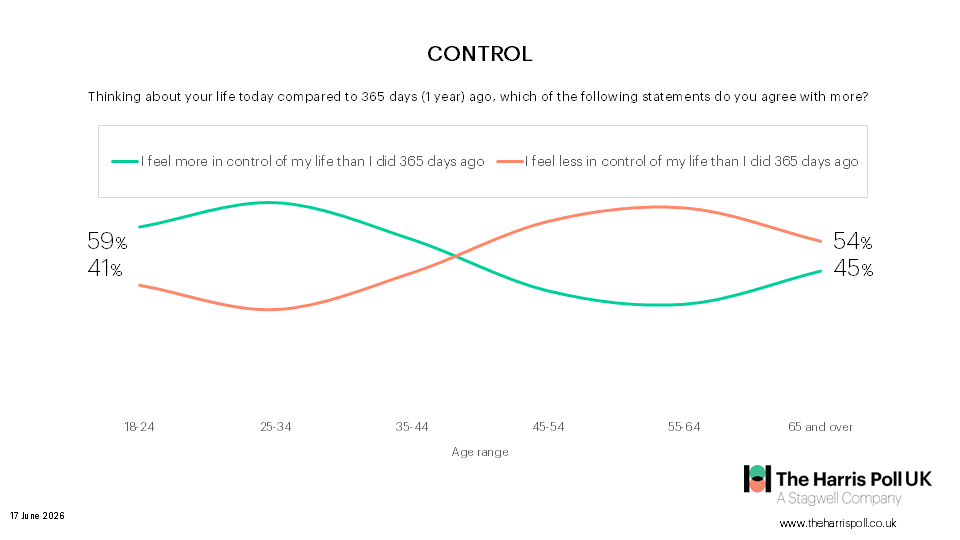
And then again when we asked whether they feel more or less in control of their lives than they did this time last year.
And finally when we asked whether their trust in institutions and organisations has increased or decreased over the last year.
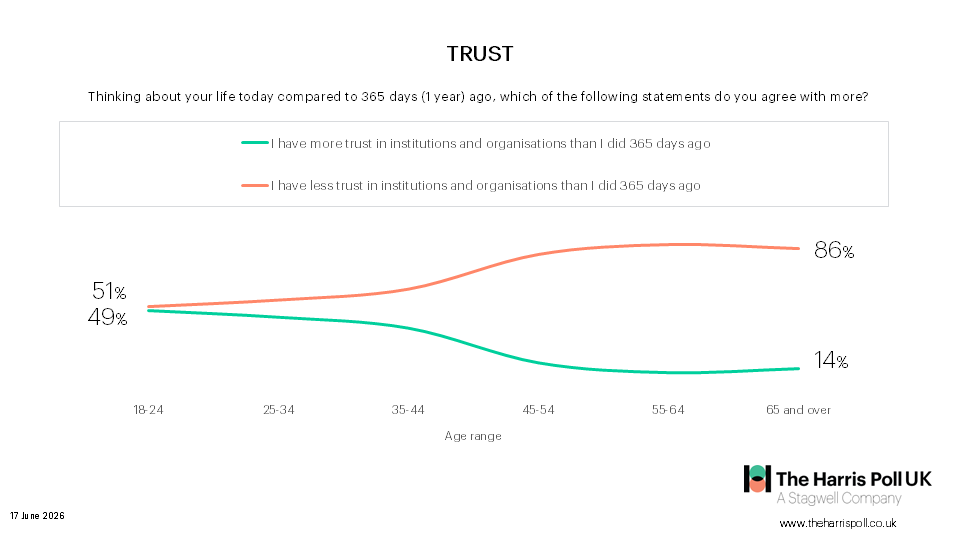
That’s four different questions with four remarkably similar stories. At first glance, this looks like a generational divide. Younger people appear more optimistic, more excited, more trusting and more in control than their older counterparts.
The real divide might not be generational, but rather different perceptions of control
These measures move together. The people who feel most optimistic about the future also tend to be the people who feel most excited about it. They are more likely to feel in control of their lives and more likely to have found a way to retain trust by carefully selecting the institutions they put around them.
Conversely, those who feel least optimistic are also more likely to feel that control has slipped away and that trust has been eroded.
Consumers are rarely as resistant to change as businesses fear. What they struggle with is feeling that change is happening around them rather than with them.
When people feel informed, involved and in control, uncertainty can feel exciting. Challenges can feel like something to overcome and change can create opportunity.
When that sense of agency disappears, the same events can feel very different. Change becomes something imposed. Uncertainty becomes something to endure. Trust becomes harder to maintain.
The defining divide in the UK today may not be political, geographic, demographic, or even economic. It may simply be whether people feel they have the ability to influence what comes next for them.
Artificial intelligence offers an interesting example to bring this to life
If we listened only to the headlines, we might assume consumers are becoming increasingly fearful of AI. But our research shows that while concern does increase with age, outright rejection remains relatively rare. Many people tell us their views have not fundamentally changed over the last year, while others remain genuinely excited about the opportunities the technology could create.
Consumers are not responding to AI with either blind enthusiasm or blanket resistance. Most are approaching it with a blend of curiosity, caution and pragmatism. They are seeking their element of control in an uncertain landscape.
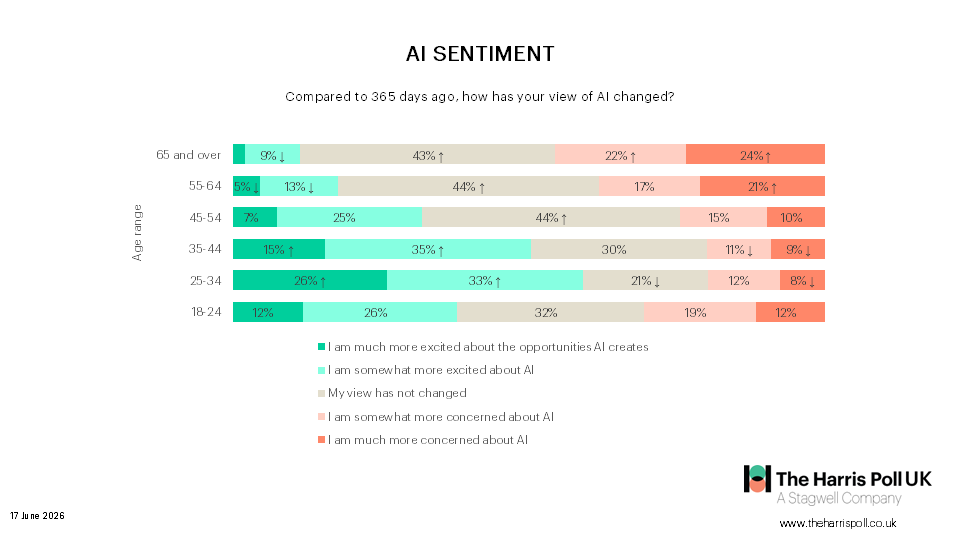
That feels consistent with much of the research we've conducted this year:
Financial Services: Consumers are embracing digital tools and innovation, but not at the expense of trust, transparency and access to human support. The organisations earning confidence are those helping customers feel in control, particularly during moments that matter most.
Retail: Cost-of-living pressures continue to shape behaviour, but consumers are making nuanced trade-offs rather than simply spending less. Own-label products have become a natural ‘good-enough’ compromise in many categories, while branded treats and small indulgences remain important sources of enjoyment and normality.
Travel: Consumers are taking longer to make decisions, weighing affordability and uncertainty more carefully than before. Yet demand remains resilient and holiday plans are being delayed, reconsidered or adapted rather than abandoned altogether.
Tech: Consumers are approaching new technologies with curiosity, caution and pragmatism. They are less focused on whether change happens and more focused on understanding how it will affect them, where it creates value and who remains accountable when things go wrong.
Across these very different sectors, and many more, the same principle keeps emerging. Consumers are remarkably adaptable when they feel equipped to navigate change. The challenge facing consumers is therefore not change itself; it is whether they feel equipped to navigate it.
The challenge behind the challenge
Challenge is not just something we experience, it’s something we respond to. Challenge itself is not the problem, every generation has faced it. The bigger question is whether people feel they have the agency, support and confidence to respond.
Helping people answer that question positively will be one of the most important things businesses, institutions and leaders will do over the next 365 days. For us at The Harris Poll UK, that is exactly where research has a vital role to play.
Over the last year, we've had the privilege of helping organisations understand the people they serve during a period of extraordinary change. If this year has reinforced one belief, it is that understanding consumers means understanding not just what people do, but how they experience the world around them.
As we celebrate our first anniversary, we're incredibly proud of what we've built alongside our clients, partners and colleagues. We look forward to helping our clients navigate the opportunities, and challenges, of the next 365 days, to staying close to the people they serve, and to continuing our mission to bring the voice of consumers into the conversations that shape their future.